

Happy Thanksgiving!
As we reflect on Thanksgiving, it’s essential to consider what it truly means to express gratitude, how popular culture, like The Peanuts, reminds us of these values, and, even more importantly, what it means from a biblical perspective.
Thanksgiving Should Be in Every Season!
Gratitude isn’t reserved for just one day or season. Instead, it should be a continual practice in our lives, shaping how we approach each day and every situation.
Be Thankful Without Grumbling
God calls us to be thankful in all circumstances, encouraging us to show gratitude without complaining. True thanksgiving is more than just a seasonal act or a spoken obligation; it’s a heartfelt response to God’s goodness.

Scriptural Patterns of Complaining and Gratitude!
The theme of gratitude—alongside its opposite, grumbling—is woven throughout Scripture. There are countless passages that address this very issue. After the fall of Adam and Eve, a pattern of complaining emerges early in the biblical narrative. Humanity’s tendency to grumble did not go unnoticed by God. For example, even after God repeatedly rescued and provided for the Israelites, they still responded with complaints rather than thankfulness. Their journey from slavery in Egypt was marked by moments of dissatisfaction and murmuring, despite God’s ongoing faithfulness and provision.
The Power of Intentional Gratitude
Practicing intentional gratitude is not only a spiritual discipline but also a therapeutic one. When we consistently choose to give thanks, it positively impacts our emotional well-being and leads to greater happiness. This deliberate act of gratitude should become an integral part of our daily lives, rather than something we do only occasionally or out of obligation.
Gratitude has a profound effect on our minds and bodies. When we express thanks, it releases dopamine, a chemical in the brain associated with feelings of pleasure and satisfaction. This release contributes to healing, both spiritually and mentally. By focusing on gratitude—even when it feels difficult or misplaced—we begin the process of healing our spirit and mind. Making gratitude a daily practice helps us find joy and peace, regardless of our circumstances.
Even God stated this in Philippians 2:13- 15: For it is God who works in you to will and to act on behalf of His good purpose. 14 Do everything without complaining or arguing, 15 so that you may be blameless and pure, children of God without fault in a crooked and perverse generation, in which you shine as lights in the world…
Be the light even when you are healing! Be the light of gratitude!
Peppermint Patty’s Thanksgiving Prayer: Obligation vs. True Thanksgiving
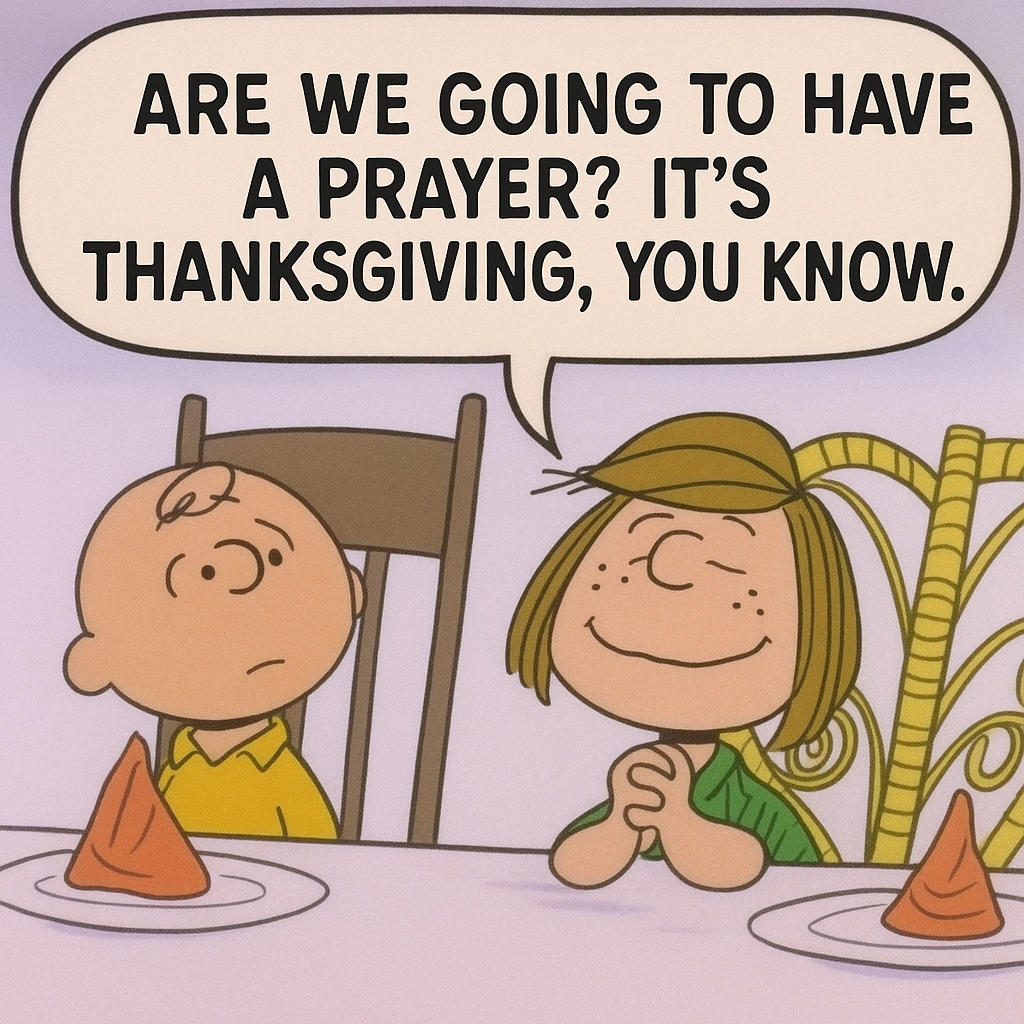
Obligation vs. True Thanksgiving
Peppermint Patty’s call to prayer before being served at Thanksgiving—“it’s Thanksgiving, you know”—was made out of obligation, not out of true thanksgiving. This raises an important question for us: Do we pray simply because it’s what we are supposed to do, or because we are truly thankful and blessed?
Jesus’ Approach to Prayer: Necessity, Not Obligation
Unlike the obligatory prayer of Peppermint Patty, Jesus saw prayer as a necessity in His life, no matter how busy He was. He always made time to pray, understanding the importance of spending time alone with the Father. Scriptures show this repeatedly:
- Luke 5:15–16: Even as news about Jesus spread and crowds gathered, He frequently withdrew to the wilderness to pray.
- Luke 6:12: Jesus went out to the mountain and spent the night in prayer to God.
- Mark 1:35: Early in the morning, while it was still dark, Jesus got up and went out to a solitary place to pray.
- Matthew 14:23: After dismissing the crowds, Jesus went up by Himself to pray and remained alone into the evening.
- Additional references: Matthew 26:36; Mark 6:46; Luke 9:18; Luke 9:28; Matthew 17:1; John 6:15.
Prayer, for Jesus, was never a meaningless function or duty squeezed into the busy or weary ends of the day. It was a vital connection to God.

Listening in Prayer!
Prayer is not just about talking; it’s also about listening. If we’re preoccupied with the day’s worries and drama, or complaining while we pray, we might miss God’s answer. Sometimes a solution is present, but we need to stop and listen to hear it.
Reasons We Struggle with Prayer
- Lack of discipline: We’re too busy, so prayer gets crowded out by urgent demands.
- Lack of belief: We don’t believe God will do anything, so we don’t bother to ask.
- Lack of intimacy: We may not feel close to God, and He seems distant.
- Lack of need: When life is going well, we often pray less, feeling no great need. But when we’re overwhelmed, we are drawn to prayer. Sometimes we falsely assume prayer is only necessary for problems we can’t handle on our own.
Peppermint Patty’s Disappointment:
Expectations vs. Reality
When Peppermint Patty opened her eyes and saw the Thanksgiving spread—toast, jelly beans, popcorn, and pretzel sticks—she exclaimed, “What’s this? A piece of toast, a pretzel stick, popcorn? What blockhead cooked all this?! We came all the way across town for this?” Her expectations from her obligated prayer did not match the outcome.

True Gratitude: Heart Knowledge Over Obligation
In 1 Thessalonians 5:16-18, Paul writes: “Rejoice evermore. Pray without ceasing. In every thing give thanks: for this is the will of God in Christ Jesus concerning you.” Paul’s instructions emphasize that our gratitude should be heartfelt, not just a duty. We are called to be thankful in all circumstances, not only when it’s easy or pleasant. We are to trust God’s ways, even when we don’t understand, and appreciate the gifts He has given instead of focusing on what we lack.
The Problem with Conditional Gratitude
When we say “thank you” and immediately follow it with a “but,” our gratitude is undermined. The word “but” completely erases the appreciation that came before it. For example, if we say, “I am sorry but…,” “I am thankful for my blessing but…,” or “I know you are there but…,” the presence of “but” exposes a lack of sincere thankfulness or faith.
Expressing genuine gratitude means doing so without reservation, exception, or condition. We should strive to communicate our thankfulness clearly and wholeheartedly, without letting a “but” diminish its impact.
It is important to be careful not to show our “but’s” when we are addressing those we claim to love. If we truly mean what we say, we should state it plainly, without following up with another statement that lessens its significance.
Making Gratitude Statements Without Conditions
By practicing clear and unconditional declarations like these, we nurture a spirit of true gratitude. This approach helps foster healing and deeper relationships, as our words communicate sincerity and appreciation without reservation.
Let those words stand on their own. By practicing these declarations without adding a “but,” genuine gratitude is allowed to grow. And where gratitude flourishes, healing naturally follows.

Charlie Brown’s Gratitude Therapy
Charlie Brown, in a moment of honesty, remarked to Snoopy, “One day we’re all going to die.” Snoopy, with his characteristic optimism, replied, “Yes, but all the other days we’re going to live!” This exchange highlights a powerful truth: choosing to focus on the days we have and the moments we can cherish, instead of dwelling on what is inevitable, fosters a spirit of gratitude.
As someone once said, “Gratitude is the language of heaven, and we should make it our language on earth.” This perspective encourages us to adopt thankfulness as our daily practice, reflecting the attitude expected of us not just in eternity, but here and now.


Examples of Thankfulness in Scripture
In John 11:41-42, when Jesus stood at the tomb of Lazarus, He prayed, “Father, I thank you for hearing me. I know that you always hear me, but because of the crowd here, I have said this, that they may believe that you sent me.” Even in the face of loss and grief over His friend’s death, Jesus expressed gratitude to God, confident that He is always heard.
Likewise, at the Last Supper, Jesus took the cup and gave thanks, as recorded in Matthew 26:27-28: “Then He took the cup, gave thanks, and gave it to them, saying, ‘Drink from it, all of you. This is My blood of the covenant, which is poured out for many for the forgiveness of sins…‘” Even while fully aware of the suffering and crucifixion that lay ahead, Jesus chose to give thanks.
The apostle Paul also urges us in Ephesians 5:20 to live with gratitude: “Giving thanks always for all things unto God and the Father in the name of our Lord Jesus Christ.”

Choosing Gratitude Over Hardship
These examples encourage us to stop counting our hardships and trials and instead start counting our blessings. Rather than focusing on what we have lost, we are called to thank the Lord for what we have left. God’s continual giving and forgiving nature is far more deserving of our thanksgiving.
When we practice gratitude, we not only bless the heart of God, but our own hearts are blessed in return. Gratitude becomes a source of healing, peace, and renewed perspective, shaping our outlook every day.
Cultivating a Thankful Heart

1. Intentionally Remember God’s Past Faithfulness
One effective way to foster gratitude is to deliberately recall the ways God has been faithful in the past. When we keep our attention on what God has already accomplished, rather than on what remains undone, the tendency to complain begins to fade away. Reflecting on God’s prior acts of kindness and provision helps us appreciate His ongoing work in our lives.
2. Shift Your Focus From What’s Missing to What’s Present
Grumbling often results from an emphasis on what we lack. In contrast, gratitude centers on the abundance already present. By training ourselves to recognize and appreciate the good gifts right before us, we can move beyond feelings of scarcity and cultivate a sense of thankfulness for all that we have.
3. Choose to Give Thanks Before You Feel Thankful
Gratitude is more than an emotion—it is a conscious decision. Colossians 3:15 encourages us to “be thankful,” presenting gratitude as an act of obedience rather than a feeling to be passively awaited. Speaking words of thanks aloud, even when our hearts don’t initially feel grateful, can lead our emotions to eventually follow. This practice reminds us that thankfulness is a choice we make, regardless of our current feelings.
4. Be Joyful!
Joy is not something to postpone until God resolves every difficulty or heals every wound. Many find themselves merely surviving their problems instead of actively pursuing joy. Psalm 40:16 says, “May all who seek you rejoice and be glad in you!” The promise is that joy and gladness belong to those who keep their eyes fixed on Jesus, even in life’s storms. Looking to Jesus more often than to our troubles helps us experience unshakable joy.
5. Love God’s Salvation
Psalm 70:4 declares, “May those who love your salvation say evermore, ‘God is great!’” Regularly considering how God has saved us—and continues to save others—leads us to delight, rest, and love His salvation. The more deeply we cherish what God has done for us, the more naturally praise overflows from our lips for the God who saves.
6. Bring Everything to God With Thanksgiving, Not Just Complaints
Difficult days are inevitable, and holidays may not always be peaceful or perfect. Even so, we are invited to maintain hearts full of thankfulness by remembering not only what God has done, but most importantly, Who He is. Our gratitude is rooted in Christ Himself—His enduring faithfulness, His love, and His unchanging character. This is the foundation for giving thanks every day.
A Prayer for a Grateful Heart
Heavenly Father,
I ask for Your forgiveness for the moments when I have grumbled and complained, choosing discontent over gratitude. So often, my expectations overshadow the joy You offer, and my focus shifts from Your steadfast goodness to the difficulties in my circumstances. Lord, make me aware when this happens and redirect my heart toward thankfulness.
Teach me to move beyond understanding gratitude in my mind alone; let it become a deep conviction in my heart. Grant me eyes that clearly see Your faithfulness in every situation, a mind that chooses to dwell on what is good, and a voice that speaks words of thanksgiving—even when my emotions do not yet align. Remind me that giving thanks is an act of obedience and trust, not just a feeling.
Thank You, Lord, for being always worthy of my praise, no matter what I face. In every circumstance, help me to honor You with a spirit of gratitude.
In Jesus’ Name,
Amen.